Visual communication is a very important part of feline communication. Cats read cat behavior signals better than people read cat behavior signals. To humans, cat visual communication signals can seem very subtle. The use of eyes, ears, mouth, tail and coat all are involved in visual communication in cats.
The most immediate visual communication cue with cats is pupil size and shape. Round pupils are associated with fear. Oblong pupils are associated with aggression. Slightly off-round pupils are associated with a relaxed state. The more intense the emotion, the more dramatic the size change of the pupil that occurs. Pupil size can also vary due to light conditions in the room, so this has to be taken into account. People, however, often cannot discern changes in pupil size until it is too late.
Facial communication signals change quicker than body posture communication signals. Ears movements in cats change very quickly. Erect ears indicate an alert cat (such as a cat that is interested in something like a bug, bird or falling leaf). Swiveled ears, with the inside of the ear sideways are an aggressive signal (this can mean if you come closer, I will strike or if you simply move I will strike). Ears down and sideways are more scared and defensive or submissive (do not come any closer). Ears pulled down so the inside cannot be seen mean the cat is extremely scared and defensive and that aggression likely will occur (aggression is imminent if the situation is not immediately remedied).
Tails are also very useful in cat visual communication. A tail that is out and behind the cat means a happy, alert, confident cat. If the tail is erect and slightly curled, the cat is an outgoing, friendly, relaxed cat. Tails that are held straight down are associated with aggressive or scared cats, even if not bristled. Tails between the legs indicate submission. A tail that is straight up and bristled is a reactive cat and facial signals will be needed to understand what the cat is really thinking.
Body posture as feline visual communication is reflected in the collective position of the head, back, and legs. For example, a head up, back straight, with tail out and behind means the cat is relaxed but alert. A cat with straight legs, with an elevated rear (“rump hump”) and a down bristled tail, means the cat is taking an aggressive position. If the cat is crouched down with the chest on the ground, a tail on the ground to one side, this is a scared cat that may become aggressive. A “Halloween cat” posture means that the cat is very reactive and can attack if threatened.
Visual Communication is just one way that cats communicate. They know what they are saying but we have to be very alert and very sensitive to the quick, fluid changes that occur. Often a cat will lash out with seemingly no warning. The cat gives what she thinks is adequate cues that if we do not alter our behavior, she will strike. Humans are just very inadequate at perceiving the subtle cues of cat language.
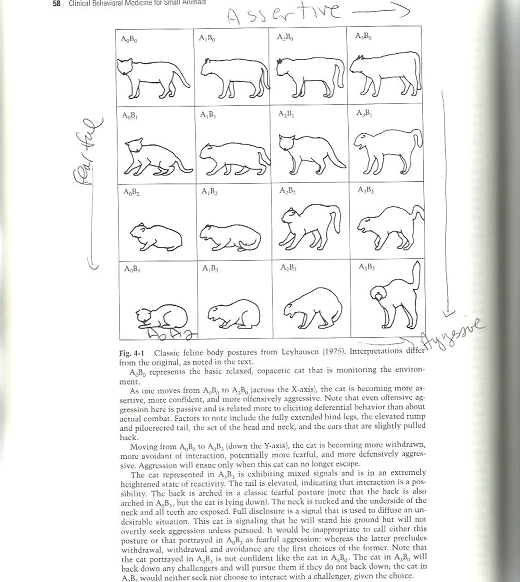
Reproduced from “Clinical Behavioral Medicine for Small Animals” by Karen L Overall
Copyright 1997 by Mosby, Inc. DO NOT DUPLICATE
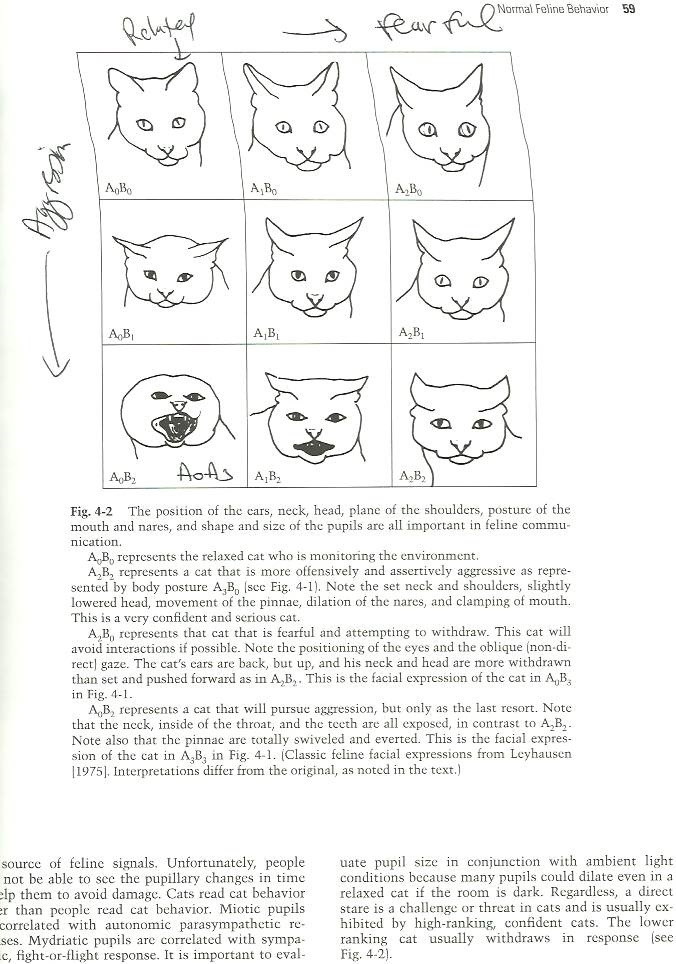
Reproduced from “Clinical Behavioral Medicine for Small Animals” by Karen L Overall
Copyright 1997 by Mosby, Inc. DO NOT DUPLICATE